
Meta used its November 18 engineering update to describe how it moves an improvement from one advertising ranking model to others. The company estimates that agents have handled more than 60 percent of that work since they began driving execution in March. It reports that an engineer can handle roughly three times as many adaptations and that selected combinations used a median of about one quarter of the previous training compute. Meta puts the prospective end-of-year compute savings at more than $45 million. The first thing a buyer of automation should notice is what Meta defined before measuring. The unit of work is an adaptation of a particular technique to a particular model. The company already has a way to confirm if that adaptation is worth releasing. Meta’s November engineering update
The most transferable choice is to put automation beside a repeatable decision, with access to prior attempts and a clear route to approval. In Meta’s case, the repeatable question is whether an improvement discovered in one place will help a different model under its own constraints. The answer still requires evidence, and an engineer still needs to decide where to concentrate time. A company that has those elements can ask how much useful work its agents are helping it finish. A company still debating what counts as a sound result will get a longer queue of proposals to debate. It is the quality of the rollout process that makes the new rate meaningful.
An improvement needs another test every time its surroundings change#
Meta uses many ranking models for different product surfaces and advertising objectives. A model can have its own training data, features, serving budget and architecture. A training change that improves one model can raise the cost of another or depend on a feature it does not have. The company can start with an idea that worked somewhere, decide where it looks promising, adapt it, check it and decide whether to send it to live traffic. This is familiar work for engineers maintaining a family of products. The scarcity is people who know why a past change worked and have time to apply that knowledge before the next improvement arrives.
The distinction between discovery and rollout also keeps the comparison honest. Meta’s March description of the Ranking Engineer Agent concerned forming hypotheses and managing experiments for newer ideas. The November update is about getting a technique that has already shown promise into more applicable models. One effort finds a change worth trying. The other evaluates when it can travel. Both can run for several days, and both can benefit from reducing manual follow-up, but their baselines and useful outputs are different. A manager looking for a pilot should choose between those jobs explicitly. Asking a team whether its agent can improve ranking without describing the kind of work leaves too many outcomes open to interpretation. Meta’s March account of experimental work
There is an economic reason to care about the time a change spends waiting. An improvement in a fast-moving system has a limited period in which it matters. A replacement model or a revised product goal can overtake an adaptation still sitting in the queue. The value of releasing sooner can come from reaching the models that have the most to gain while the improvement remains useful. It depends as much on which model is chosen as on how many jobs the team starts. A defensible way to assess a rollout pilot would track the time until a qualified change reaches production, the evidence available at the moment of prioritization and the reasons certain models were left out.
Shared templates make many small decisions disappear into a common one#
Meta’s accompanying engineering article describes standard model templates. The templates give groups of models common choices in architecture, training and serving. Engineers can run a set of tests against representative models and use the result to improve the shared template. A common design also gives an agent some starting knowledge about which settings are likely to work. That matters because repeated testing on incompatible model configurations can consume capacity even with a very capable agent. At the same time, the linked account says teams retain specific logic where required. Convergence on a template is useful when it follows real similarities in workloads and makes their remaining differences easier to see. Meta’s account of standard model templates
A different company can look for the equivalent of a template without assuming it needs a fleet of ad models. A product team adapting a reporting workflow across offices may find that several offices use the same schema and have a common output standard. An organization adjusting a forecasting model across markets may find that a handful of serving requirements recur. Those shared elements can make it practical to run one representative comparison and know which differences need their own test. The value lies in specifying the work beforehand. A process with an explicit baseline makes it possible to ask whether the next proposal reproduced something already learned and whether skipping a separate experiment is justified.
There are limits to consolidation. A model responsible for a large share of revenue or one with a tight service constraint may deserve bespoke evaluation. Meta says experts still drive bespoke adaptation for its highest-revenue models, with agents learning alongside engineers and handling parts of the work. An organization might likewise keep direct specialist involvement where a regression would have a large cost. Time spent there can be a deliberate allocation of engineering attention. A decision about standardization should spell out which teams or workloads can use the shared process, what evidence lets another join and who decides when a specific case has enough at stake to keep a separate path.
Earlier screening changes what gets a share of the budget#
Meta describes a process that presents candidate adaptations and prioritizes them by estimated benefit. A useful candidate combines a particular change with a particular receiving model and a reason the two belong together. Selection affects the whole program because combinations that never appear will have no chance to show value. If the system shows every plausible pairing, training and review can be swamped by low-value attempts. Meta says it evaluates how many selected models eventually ship the technique and how many of the viable models were surfaced. The two measures answer different questions. Together they can help an organization see if an apparent efficiency gain has come from becoming too narrow.
This part of the process also benefits from an experiment record. Meta describes using past training runs and each model’s properties to choose starting configurations, adjust subsequent trials and end runs that look unpromising. The organizational asset is the accumulated record of comparable decisions. It matters whether results include unsuccessful attempts. A catalog that stores only wins hides useful information and can make agents keep repeating costly work a person already attempted. Other teams can begin by collecting the reasons people reject changes as well as the changes they approve. That practice helps people and software tell failure due to a poor candidate apart from failure due to a broken test.
An agent can also point too confidently to an incomplete record. Results that worked under one model version can lose relevance after a change in data or infrastructure. If old performance has become the sole basis for prioritizing work, a team can repeatedly miss a new case. A good decision process therefore gives maintainers a way to date the evidence, record how a candidate was judged and revisit the cases that were not selected. Teams with a recurring pipeline can schedule a modest number of deliberate checks outside the top-ranked choices. The information from those checks helps them learn whether the prioritizer is missing a class of valuable work before the omission becomes a permanent assumption.
One number for labor, another for compute, another for elapsed time#
The figures in the announcement broadly describe more available engineering time and more deliberate use of training compute. The 60 percent figure refers to the company’s estimate of the share of propagation work agents handle. The threefold measure describes adaptations an engineer can handle. The median training-compute reduction comes from selected technique and model combinations. The projected savings are Meta’s estimate for year end. All four can be encouraging together. Each still needs its own denominator and comparison. A team cannot use the compute figure to infer that its AI program will pay for itself while it has no estimate of implementation, review and maintenance costs.
A sensible cost comparison also assigns expense to failed candidates and to the work that happens after a trial. One option might avoid an expensive test by screening with less compute, while increasing review of the saved proposals. Another might require a more expensive experiment but lead to fewer repeat attempts or quicker approval. A cost calculation should record both planning and execution, including the necessary people, the compute used and downstream maintenance. When the recurring job is adapting and shipping a proven change, the denominator can be accepted adaptations that meet the same release criteria across the old and new paths. Counting all attempts separately helps reveal when some savings stem from stopping waste early.
Elapsed time belongs in the calculation because spending less and shipping earlier are distinct outcomes. An engineer may be available to review more work even while a queue of data or compute tasks lengthens. More experiments per person can be worth celebrating in a project report, while a business manager also needs to know whether the release dates moved. Meta says propagation across all applicable models can exceed a year and sets a goal of shortening it to three months, with an associated target of about five times the end-to-end throughput. It describes a direction to work toward. A company with a similar aim can record time in each queue and measure where an intervention actually changes the result.
Use release checks that exist beyond the agent’s own report#
Meta says candidate techniques go through predictive performance and cost constraints before live experiments. Scaled-down models can screen adaptations relatively cheaply, while full-size representative models test survivors before broader adoption. For a change to ship, Meta also requires a statistically significant gain in online testing under its criteria, with humans approving what goes live. Each point answers a different question. A cheap test helps decide whether a combination merits more resources. A more representative one establishes whether the improvement holds under realistic conditions. A live comparison and approval deal with the decision to expose the change to the business and its users.
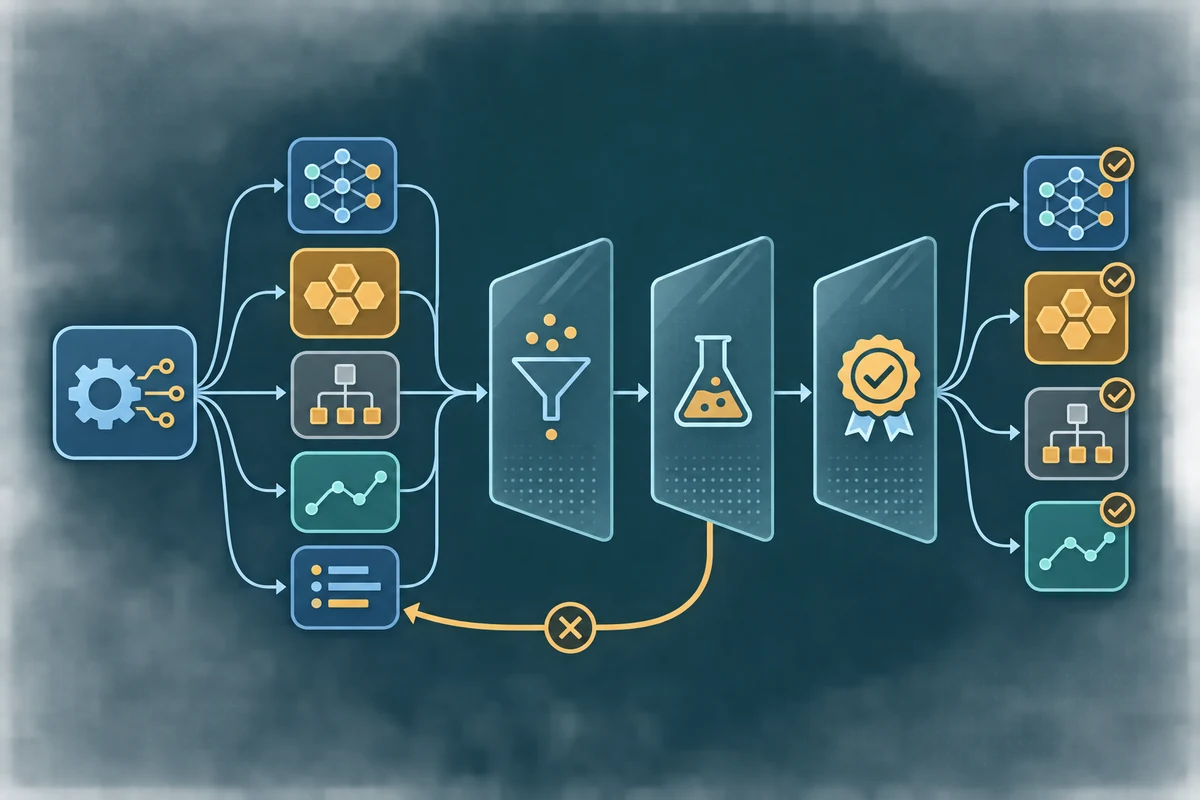
This has a direct implication for automation pilots. The owner should be able to point to evidence that would hold up if the person writing the report never saw the agent’s explanation. A team changing a repository assessment process might establish external review for the same set of outputs. A group altering a forecast might compare the old and new system on held-out historical periods and check behavior on new data before adopting it. Those are different domains with the same responsibility. The proposal can be generated quickly. Its release still depends on people who can independently see the outcome against a defined standard.
The approval rule is most useful when its responsibility is specific. An engineer can own the decision about whether a measured improvement survives representative conditions. An operations team can own a limit on budget and capacity. A product owner can confirm whether the test reached the right users and what happens if the change has to be reversed. If everything waits for the same person, the system will create a different bottleneck. Naming the decisions helps distribute work while preserving accountability. Name the kinds of failure that require a human intervention too. An agent can recover a stalled training process and still need an owner to reconsider a misleading result.
Plan for capacity when cheaper trials make it easier to start more trials#
Meta says its agents can manage long-running experiments and help prioritize jobs across shared resources. That is a strategic function once a team runs enough experiments to contend for the same capacity. Reducing the cost of an individual run can open space for more runs, which in turn raises demand on scheduling, review and storage. Total spending may remain steady or rise while accepted output improves. This can be a reasonable business outcome. It needs a different accounting statement from cutting the budget. A manager should know whether the project is meant to free capacity, produce more useful changes within the same allocation or reduce the time spent before benefit appears.
The priority rule also expresses a choice about whose work can wait. Meta says its system considers factors including relative revenue importance, expected potential and deadlines. Other groups may need to reserve room for reliability work, rarely used categories or upcoming system changes. If short-term benefit decides every job, a methodology that looks productive today can have little time for important cases whose value is harder to forecast. A responsible manager can agree on which resources are shared, how much is available and which decisions should leave an auditable reason, then watch whether exceptions expand or shrink over time.
In practice, this makes a pilot budget more like an operating decision than a purchase order. Set an amount of capacity for a representative set of adaptation tasks and observe what happens across the full chain. Record the portion spent on attempts that were abandoned and the reasons choices shifted. Compare that with a team handling similar changes through its current process. If the new system saves training resources but engineers spend their time resolving ambiguous review assignments, the next investment might belong in the approval process. If approvals already move quickly and capacity is the limitation, better candidate selection could have more value. Both conclusions can follow from the same release statistics without assuming every shop needs the same arrangement.
A shared rollout can share a mistake too#
A template can make it easier to spread a proven improvement and easier to spread a bad assumption. A change that looks favorable on the representative set may affect an edge case that appears only in a local model. This problem matters because a fast rollout reaches those cases sooner and makes previous behavior harder to recover if records are incomplete. A team with multiple regional configurations can decide in advance whether the first wave should cover high-value or lower-risk cases, and keep a record of the version used in every group. Those precautions preserve much of the benefit of reuse while giving maintainers a way to localize unexpected results.
Separate release criteria are useful for common traffic and for groups that could react differently. Imagine a forecasting team that introduces a new training adjustment for a family of stores. The typical group might show improved aggregate error, while the subset with seasonal demand gets worse. A wider rollout can be worthwhile only with enough evidence about which pattern the receiving store follows. A sensible stop rule gives the owner a reason to pause before a favorable average obscures the loss. Staging and rollback make the experiment reversible while the team learns whether its template groups really have enough in common.
There is also an operating question about records between teams. The people who devised a technique might understand why they used one setting, while the people who have to maintain it later only see the current version. An adaptation record can capture the source technique, the target workload, the conditions that justified it, evidence from the tests and the owner of the production result. If it fails, the next team needs to know if the underlying idea was ineffective or whether the implementation changed. Keeping those details understandable improves the value of the work for both later engineers and agents that consult old evidence.
Clear responsibility can be more useful than a rule that sends every concern to a central committee. Local maintainers can confirm whether a new configuration is behaving as expected, while the shared owner tracks whether the same issue is emerging in several places. There should be a named decision maker for a roll back and a clear way to find the previous version. A team can check that recovery path with an unimportant change during its trial. That small test brings the strategic promise down to a practical question: if the new process changes a dozen places at once, who knows where it changed them, and can that person restore the last known state?
What a team would have to see before expanding the trial#
To run a small version of this experiment, a team can pick a change it has already validated once and list the places it could plausibly apply. Choose a few typical cases and at least one place where a difference might make the change unsuitable. Preserve the existing process for comparison. Give the agent read access to the appropriate evidence and record each adaptation as a separate decision. At the end, check completed work, queue time, compute and review effort, with the same quality standard. If the agent proposes interesting work that fails the release checks, the right conclusion is that it helped with exploration. The result can be useful without implying the team is ready to automate production.
Expansion is justified when the chosen group sees greater accepted output or quicker, cheaper delivery at comparable quality. It also helps to see who picks up the exceptions and whether the team can explain a result without asking the agent to justify its own work. The evidence would be stronger if the result persists when workload mix changes and if held-out cases behave as expected. Conversely, a drop in the share of viable changes surfaced, an increase in harmful regressions or a lasting review queue would support narrowing the program. These are operating signals, so the measurement period should run long enough to observe both initial training and an ordinary cycle of releases.
The value of Meta’s disclosure is that it gives these questions a concrete setting. Faster rollout can be valuable while firm limits on compute and approval remain in place. The return another company can expect depends on shared parts of its workflow, evidence it can reuse and the consequence of a bad decision. Meta’s figures are an internal report from one large platform and useful as a case, with its targets still to be met. A sensible first investment is to make one recurring change easy to evaluate end to end. When the organization can see what passes and who approves it, it can measure whether an agent actually makes the useful work travel faster.